The vanity is the workhorse of your bathroom — it takes daily splashes, steam, slammed drawers, and under-sink plumbing all at once. Here's how to pick one that actually holds up in a humid San Antonio bathroom, and when a local shop beats the big-box aisle.
Start with size: standard vanity widths
Vanities come in standard widths, and your rough-in plumbing and wall space decide which ones will fit. The common sizes are 24", 30", 36", 48", 60", and 72". As a rule of thumb:
- 24"–30" — powder rooms and small guest baths. Storage is tight, so drawers beat doors here.
- 36"–48" — the sweet spot for most hall and guest bathrooms: one sink with real counter space left over.
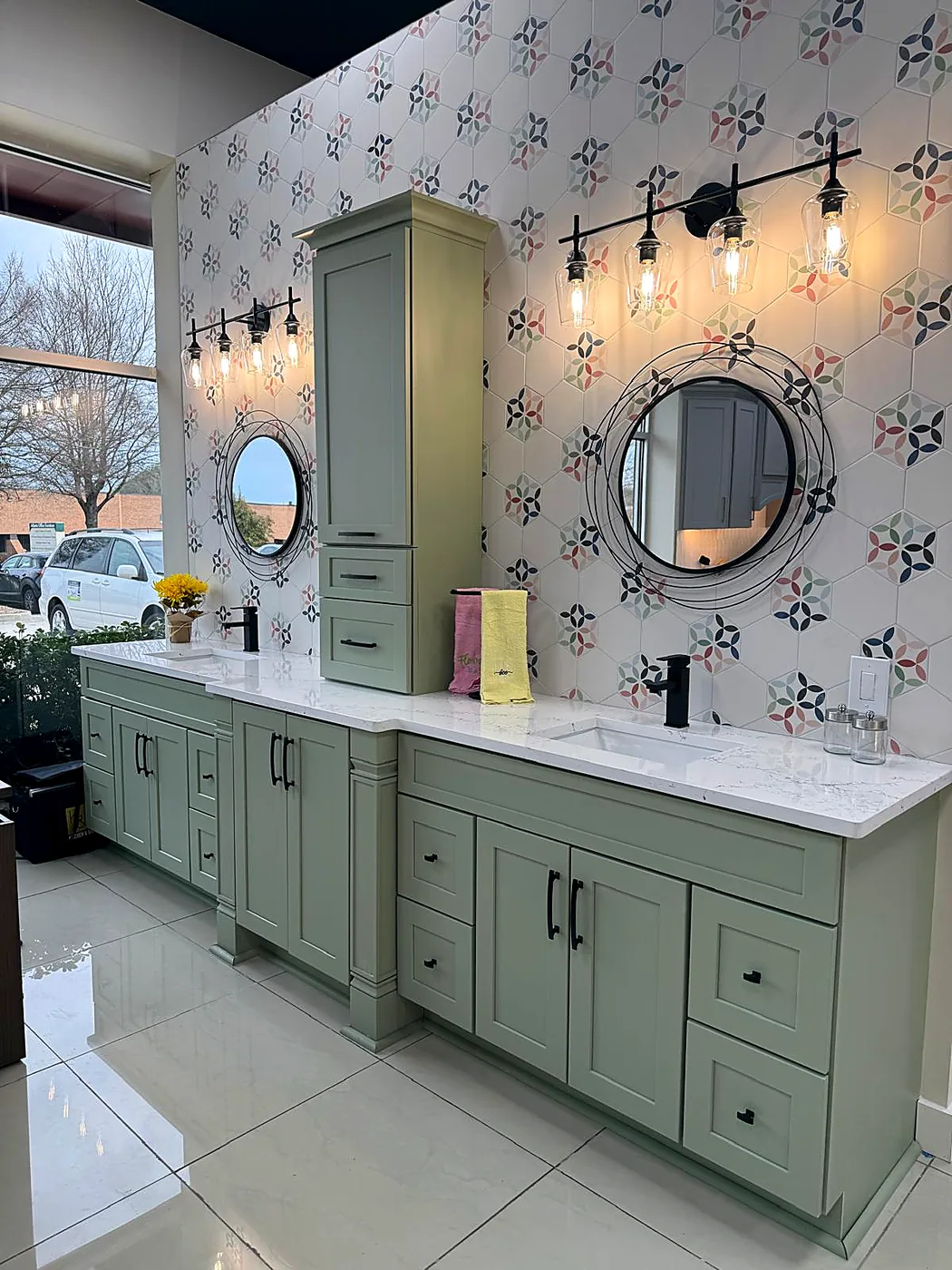
- 60"–72" — primary bathrooms. A 60" vanity is the practical minimum for two sinks; 72" gives each person elbow room and a drawer stack in the middle.
Standard vanity height is about 32", while "comfort height" — the same 36" as kitchen counters — has become the default in most new installs because it saves your back. Our vanity line covers single-sink cabinets from 24" to 48" and double-sink cabinets from 60" to 84", plus wall-mount floating styles — see the bathroom vanity page for the full lineup.
Single or double?
If two people get ready at the same time every morning and the wall allows 60" or more, a double vanity is worth it — it's also a feature buyers expect in a primary bath. If your wall is under 60", don't force it: one generous sink with usable counter on both sides beats two cramped bowls touching each other. A single-sink 48" vanity with a drawer bank often stores more than a squeezed 60" double.
Construction: what survives a humid bathroom
A bathroom is the hardest room in the house on cabinetry. Steam from every shower, splash around the sink, and the occasional supply-line drip under the cabinet all attack the box. Two construction choices matter most:
Box material. Plywood boxes handle moisture far better than particleboard or bare MDF, which can swell permanently at the edges after repeated exposure. This is the single biggest durability difference between a cheap vanity and one that lasts — we cover the full comparison in our plywood vs MDF guide. Every vanity we sell uses an all-plywood box with solid wood doors and frames, dovetail drawers, and soft-close hardware — the same construction as our kitchen lines, scaled for the bath.
Framed vs frameless. A framed vanity has a solid wood face frame around the box opening — the traditional look, very forgiving during installation on uneven walls. A frameless (European-style) vanity skips the frame, so drawers and doors span the full box width — more storage per inch and a cleaner modern face. Both work well in a bathroom when the box behind them is plywood; the choice is mostly about style and how much drawer capacity you need from a small footprint.
Countertop: quartz, granite, or cultured marble?
Most budget big-box vanities ship with a cultured-marble top — crushed stone in a resin gel coat. It's inexpensive and waterproof, but the gel coat can scratch, dull, and yellow over years of cleaning, and you're stuck with the molded sink shape it comes with. A quartz or granite top costs more up front but resists scratches and stains, takes any undermount sink you like, and matches what today's buyers expect. Because vanity tops are small — typically 4 to 13 square feet, versus 35 or more in a kitchen — upgrading the stone costs far less than it would in a kitchen, and it's the surface you touch every single day.
Big-box, online, or local semi-custom?
San Antonio homeowners have three realistic ways to buy a vanity. Each has a legitimate use case:
| Factor | Big-box stock | Online retailer | Local semi-custom (WoodArt) |
|---|---|---|---|
| Sizes | Standard widths only, take-it-or-leave-it | Wide selection, but fixed dimensions | 24"–84" with configurable storage, plus floating styles |
| Construction | Often MDF or particleboard at entry prices | Varies wildly — hard to verify before it ships | All-plywood box, solid wood doors, dovetail drawers you can inspect in the showroom |
| Countertop | Usually pre-attached cultured marble | Often sold separately, freight damage risk | Quartz, granite, or quartzite cut to your sink and faucet layout |
| Seeing it first | Yes, on the shelf | No — photos only | Yes — door samples and finishes at our Isom Rd showroom |
| Measurement & fit | You measure, you own the mistakes | You measure, returns are painful | Free in-home measurement before anything is ordered |
| Installation | Hire your own installer | Hire your own installer | In-house bilingual crew, 3-year workmanship warranty |
| Best for | Rentals, flips, tight budgets | Specific styles you can't find locally | A bathroom you'll live with for 10+ years |
Honest take: for a rental property or a quick flip, a big-box vanity is a rational choice. For your own home — especially a primary bath — the gap in box construction, countertop quality, and fit is where the extra money goes, and it's visible every day. If you want a deeper dive into choosing styles and finishes, our vanity buying guide is the companion piece to this one.
Installation gotchas nobody warns you about
Vanity installation looks simple — it's a box against a wall — but three details separate a clean install from a callback:
- Plumbing offsets. Your drain and supply lines were roughed in for the old vanity. A new cabinet with a drawer bank, a different sink position, or a floating design often needs the P-trap or supply stops moved a few inches. Skip this check and you end up cutting up the back of a brand-new cabinet on install day.
- Wall anchoring. Every vanity should be screwed into studs — not just drywall — and a floating vanity absolutely must be, since the wall carries the entire weight of the cabinet, the stone top, and whatever leans on it. Stud locations sometimes force small layout adjustments, which is much cheaper to discover during measurement than during installation.
- Backsplash height and outlets. A standard 4" stone backsplash, a full-height tile splash, and a mirror all have to meet cleanly — and the electrical outlet has a way of landing exactly where the splash wants to be. Decide the splash treatment before the top is cut, not after.
This is exactly why we do a free in-home measurement before ordering: our team checks the plumbing rough-in, finds the studs, and confirms the splash plan so the vanity that arrives actually fits. Most vanity swaps are then done in a day or two once materials are in.
What does a vanity project cost in San Antonio?
From our San Antonio bathroom cost guide: a quality vanity cabinet with a quartz or granite top typically runs $800–$2,500 supplied, or about $1,500–$4,500 installed including the stone top, faucet hookup, and haul-away of the old unit. Double vanities and custom-cut stone sit at the higher end; a full bathroom remodel with tile and lighting runs $5,000–$15,000+. Every project includes a free 3D design — usually back to you within about 48 hours — and if you'd rather spread the cost out, Affirm monthly payments come with instant pre-qualification and no impact to your credit score.
Frequently asked questions
What does a custom bathroom vanity cost in San Antonio?
At WoodArt, a vanity cabinet with a quartz or granite top typically runs $800–$2,500 supplied, or roughly $1,500–$4,500 installed, depending on size, stone choice, and how much plumbing work is involved. In-stock styles cost far less than special order, and most in-stock vanities deliver in 3–5 business days inside the San Antonio area.
What is the standard bathroom vanity height?
Traditional vanities are about 32" tall. "Comfort height" vanities match kitchen counters at 36" and are what most homeowners choose today — the extra inches make a real difference for adults, though families with small children sometimes keep the lower height in a kids' bath.
How wide does a double vanity need to be?
Plan on 60" as the practical minimum for two sinks, and 72" or more if you want comfortable elbow room and shared drawer storage between them. Below 60", a generous single-sink vanity is almost always the better bathroom.
Can my vanity match my kitchen cabinets?
Yes. We can build your vanity in the same shaker style and finish as your kitchen cabinets for a coordinated whole-home look, or in a contrasting style if you want the bathroom to feel distinct.
See vanities in person
Stop by our showroom at 431 Isom Rd #101 — Mon–Fri 8am–6pm, Sat–Sun 10am–3pm — or book an appointment and bring your bathroom measurements or a tile sample. We'll match a finish on the spot.