Every cabinet quote you get will name a door style and a color. Very few will tell you what the box behind that door is made of — and that's the part that decides how your cabinets survive a slow sink leak, a humid Texas August, and twenty years of daily use. Here's the plain-English breakdown of plywood, MDF, and particle board.
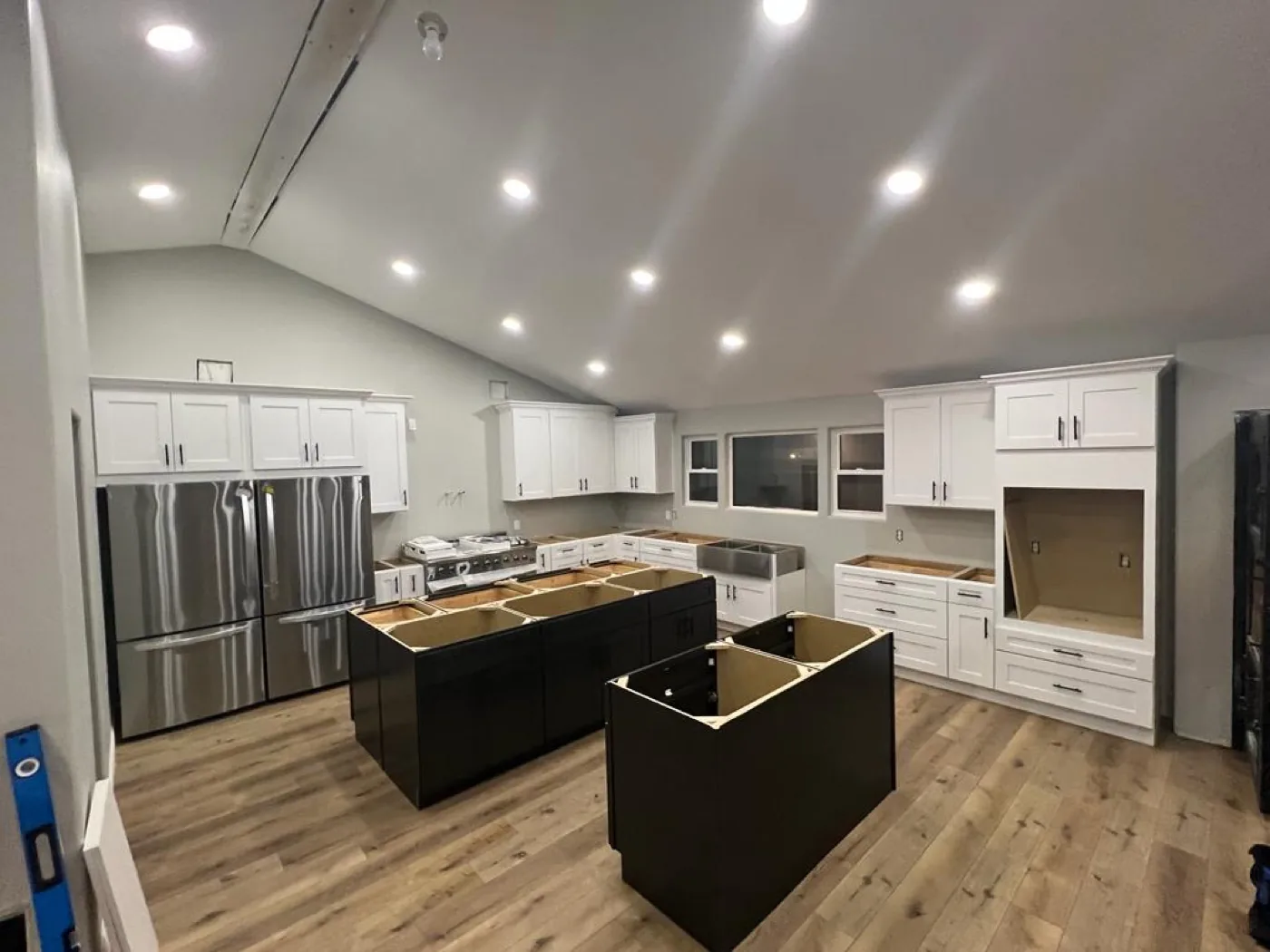
The three cabinet materials, in plain English
Almost every cabinet on the market — stock, semi-custom, or custom — is built from one of three engineered wood products. The door style gets all the attention, but the material determines the strength, weight, moisture behavior, and lifespan of the cabinet itself.
Plywood
Plywood is made of thin layers of real wood veneer glued together with the grain of each layer running in alternating directions. That cross-grain construction is why it's strong for its weight, resists sagging under a stack of dinner plates, and grips screws the way solid lumber does. It also handles moisture better than the alternatives: if plywood gets damp, it tends to dry out and hold its shape rather than swell permanently.
MDF (medium-density fiberboard)
MDF is fine wood fiber mixed with resin and pressed into a dense, perfectly uniform sheet. There's no grain, no knots, and no voids — which is exactly why it machines so cleanly and takes paint so smoothly. The trade-offs: it's noticeably heavier than plywood, it holds screws less securely (especially if a hinge screw ever has to be re-driven), and if water gets past the finish, the fibers swell and don't shrink back.
Particle board (furniture board)
Particle board is made from coarser wood chips and shavings bonded with adhesive. It's the least expensive of the three and perfectly fine inside a bookshelf or a dresser. In a kitchen — where cabinets carry real weight, live next to water lines, and get their hinges cycled thousands of times — it's the material most likely to strip a screw, sag under load, or swell beyond repair after a leak. It's common in bargain-priced cabinets, which is a big part of why those cabinets are bargain-priced.
Plywood vs MDF vs particle board: side by side
| Factor | Plywood | MDF | Particle board |
|---|---|---|---|
| What it is | Cross-laminated layers of real wood veneer | Fine wood fiber pressed with resin into a uniform sheet | Coarse wood chips bonded with adhesive |
| Screw & hinge holding | Best — grips like solid wood, screws can be re-driven | Decent on first install; weaker if screws are removed and reset | Weakest — screws strip most easily |
| Moisture behavior | Most forgiving — tends to dry out and hold its shape | Edges swell if water gets past the finish, and don't shrink back | Swells fastest and most severely |
| Weight | Lightest of the three for the same strength | Heaviest — a concern for wall cabinets | Heavy for its strength |
| Painted finish | Grain can subtly telegraph through paint | Best — paints glass-smooth with no grain showing | Needs edge banding or laminate; rarely painted well |
| Shelf sag under load | Most resistant | Can sag on long spans over time | Sags soonest |
| Typical role | Cabinet boxes and shelves in quality lines | Painted door panels and center panels | Boxes in budget cabinets and flat-pack furniture |
| Relative cost | Highest of the three | Middle | Lowest |
Where each material actually wins
Screw-holding: the hinge test
A kitchen cabinet door opens and closes thousands of times a year, and every one of those cycles pulls on two or three hinge screws. Plywood's layered real-wood construction grips threads the way lumber does, and if a hinge ever needs to be adjusted or replaced, the screws bite again. MDF holds a screw acceptably the first time but is less forgiving of re-driving; particle board is the material behind most "my cabinet door fell off" stories.
Moisture: the big one in South Texas
San Antonio summers are humid, and every kitchen has at least one cabinet sitting directly under a sink trap and a garbage disposal. The most common cabinet failure we see in older kitchens isn't a broken door — it's a swollen, delaminating sink-base floor from a slow leak nobody noticed for months. Plywood handles that scenario best: it can absorb some moisture and dry back out. MDF and particle board swell permanently once water gets in. If you upgrade the material anywhere in your kitchen, make it the sink base.
Painted doors: MDF's honest advantage
Here's where MDF genuinely earns its place. Because it has no grain, a painted MDF door panel comes out glass-smooth — no wood grain telegraphing through the finish, and no seasonal wood movement causing hairline paint cracks at the door joints. That's why many well-made painted cabinet doors pair a solid-wood frame with an engineered center panel: it's not a cost-cutting trick, it's better engineering for a painted finish. If you're comparing painted finishes more broadly, our cabinet finishes guide covers paint vs stain vs thermofoil in detail.
Weight and installation
MDF is significantly heavier than plywood of the same size. That matters most for wall cabinets, where every pound hangs off a few screws in the wall studs, and for large doors, where weight works on the hinges every day. It's one more reason the industry standard for quality construction is plywood for the boxes and reserving MDF for door panels, where its smooth paint finish pays off.
Cost: what the upgrade really buys
Plywood is the most expensive of the three materials, which is why many national brands sell particle-board boxes as standard and charge extra for a "plywood upgrade." Spread across a whole kitchen, the difference is usually a few hundred dollars — small compared to the cost of replacing a swollen cabinet run after a leak. For a full picture of what drives cabinet pricing in our market, see our San Antonio kitchen cabinet cost guide.
What we build with at WoodArt
Our cabinet lines use all-plywood box construction with 1/2" plywood, solid-wood door frames, dovetail drawers, and soft-close hardware as standard — there's no particle-board tier and no plywood upcharge to decode. A standard 10×10 kitchen in our in-stock lines starts at $1,750 for cabinets only, and every full install is backed by our 3-year workmanship warranty. You can compare the door styles in person at our cabinet showroom on Isom Rd, or start with a free in-home measurement and a free 3D design, usually back to you in about 48 hours.
One thing this article deliberately doesn't cover: whether you need stock, ready-to-assemble, or semi-custom cabinets in the first place. That's a separate decision — our custom cabinets guide walks through it.
Frequently asked questions
Are plywood cabinets worth the extra cost?
How long will plywood cabinets last?
Is MDF or plywood better for painted cabinet doors?
Which material should the sink base cabinet be?
Is particle board always a bad choice?
The bottom line
Plywood for the boxes, MDF where a glass-smooth painted panel matters, particle board for furniture — not kitchens. When you're comparing quotes, ask one question that most shoppers skip: "What is the cabinet box made of?" If the answer is vague, the answer is probably particle board.
See the difference in person
The fastest way to understand the plywood difference is to pick up a cabinet door and look inside a box. Stop by our showroom at 431 Isom Rd — open 7 days a week — or book an appointment and we'll walk you through construction, samples, and pricing. Monthly payments are available through Affirm with instant pre-qualification and no impact to your credit score — details on our financing page.