Cabinet Finishes Explained: Paint, Stain, Laminate, Thermofoil — Pros & Cons
Confused about cabinet finishes? Here's what 'conversion varnish' actually means, why thermofoil peels in San Antonio heat, and which finish lasts longest.
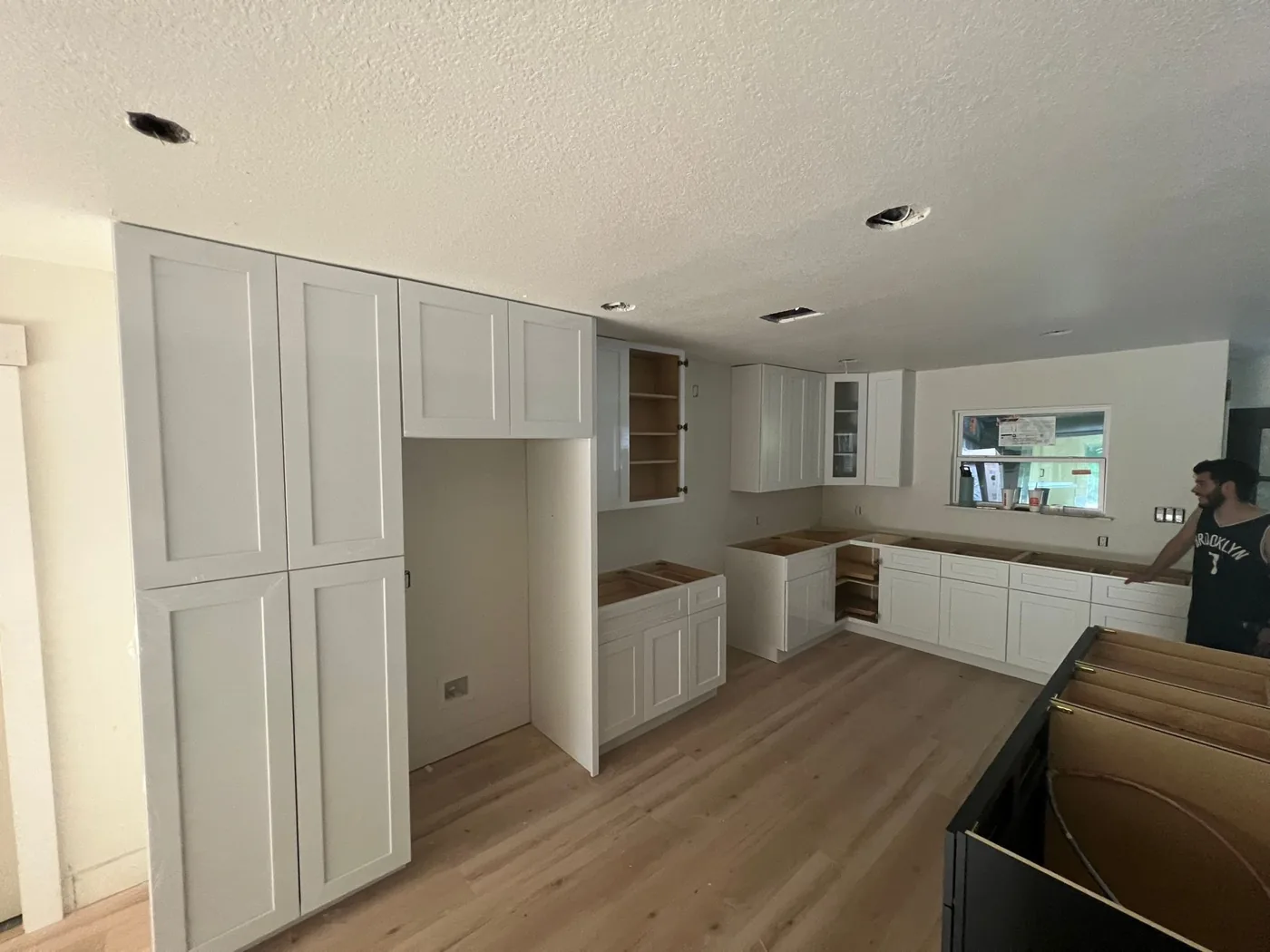
The number-one source of frustration we hear: their cabinets look beautiful at install but fail within 2 years. The cause is almost always a budget finish chosen without understanding what it is.
Paint: the finish is only as good as the cure
"Painted" covers everything from brushed-on latex to a factory catalyzed coating, and the gap between them is enormous. What you want is conversion varnish: a two-part coating where an acid catalyst is mixed in immediately before spraying, so the film hardens by chemical reaction rather than by simply drying. The result resists water, grease, and household cleaners far better than any air-dry lacquer or wall paint. It also can't be re-coated on site once cured, which is exactly why factory-finished doors outlast a painter working in your kitchen. Expect hairline cracks at the door joints eventually — that's the wood moving under a rigid film, not a defect.
Stain: hides what paint puts on display
Stain penetrates instead of coating, so a chip doesn't leave a white scar and seasonal joint movement doesn't telegraph. Species matters: oak and hickory carry heavy figure that camouflages daily wear, while maple's tight grain can blotch unless it's conditioned before staining. Under San Antonio's intense south and west light, wood ambers — doors in direct sun will read noticeably warmer in three years than the ones behind a blind. Plan for it, or put UV-filtering film on the worst window.
Laminate and melamine: cheap, flat, honest
Laminate is a printed sheet bonded to a substrate. It's dimensionally stable, wipes clean, and costs the least of anything here. What it can't do: any door profile beyond a flat slab, an invisible edge repair (a chipped edge exposes the core), or a convincing wood look at arm's length. For a laundry, a garage, or a rental it's a perfectly rational choice. For a kitchen you intend to keep 15 years, it isn't.
Why thermofoil peels in San Antonio
Thermofoil is a vinyl film vacuum-pressed over an MDF core. Film and core expand at different rates, and sustained heat eventually beats the adhesive. Here it fails in predictable places: the door above and beside the range, the panel next to a dishwasher's vent, and anything adjacent to a self-cleaning oven cycle. Edges lift, curl, and go milky, and nothing repairs it — the door gets replaced. A west-facing kitchen under an uninsulated attic accelerates the whole process. When a quote comes in dramatically below everyone else's, thermofoil doors are usually why.
What we'd pick, room by room
- Kitchen you plan to keep: conversion-varnish painted or stained solid wood door frames on plywood boxes.
- Heavy-sun kitchen: painted over stained — pigment resists UV shift better than a transparent topcoat.
- Bath or laundry: painted and sealed on all six sides.
- Budget flip: laminate slab, not thermofoil.
Judge the finish in your own light
Screens lie about color, and every finish shifts under warm Texas light. Narrow it to two or three doors from our 36 in-stock styles across five collections, take samples home, and set them against your wall at 8 a.m. and again at 6 p.m. before committing. Once you've picked, request a free quote and we'll price the same door in each finish so the trade-off becomes a number instead of a guess.
Free design + 3D rendering + in-home measurement on every project. Affirm financing available.
Get a Free Quote (210) 984-1615