Custom Kitchen Cabinets: What You Actually Get for the Money
Not a stock-vs-custom debate. A plain look at what the extra money buys you, feature by feature.
If you’re weighing stock against custom, start with our stock vs custom comparison. This article assumes you’re leaning custom already and want to know exactly what that money is buying.
Exact sizing is most of what you're buying
Stock arrives in 3" width increments — 30", 33", 36" — and the leftover gets closed with a filler strip. Custom is quoted to the inch: a 34½" opening gets a 34½" cabinet. Depth and height work the same way — a 15"-deep upper over a coffee station, uppers that die into an 8-ft ceiling instead of leaving a dust shelf.
Sizing is also how custom absorbs a wall that isn't plumb — common in older San Antonio houses on expansive clay. A settled wall gets a panel scribed to it, not a gap covered in trim.
The box: what's standard here, and what's a real upgrade
Every cabinet we sell, stock or custom, is built on ½" or ¾" plywood boxes with solid wood door frames, dovetail drawer boxes and full-extension soft-close glides. So "plywood construction" isn't what the custom premium buys here — that's the floor. Comparing materials? Read plywood vs MDF.
What custom construction genuinely adds:
- ¾" material throughout, including shelves, so long spans don't sag.
- Finished interiors and full-depth backs — visible through glass doors and on open ends.
- Integrated toe kicks and furniture bases instead of an applied kick.
- Nonstandard heights — a taller base under a raised counter, or an appliance garage.
Doors, overlay, and the real cost of inset
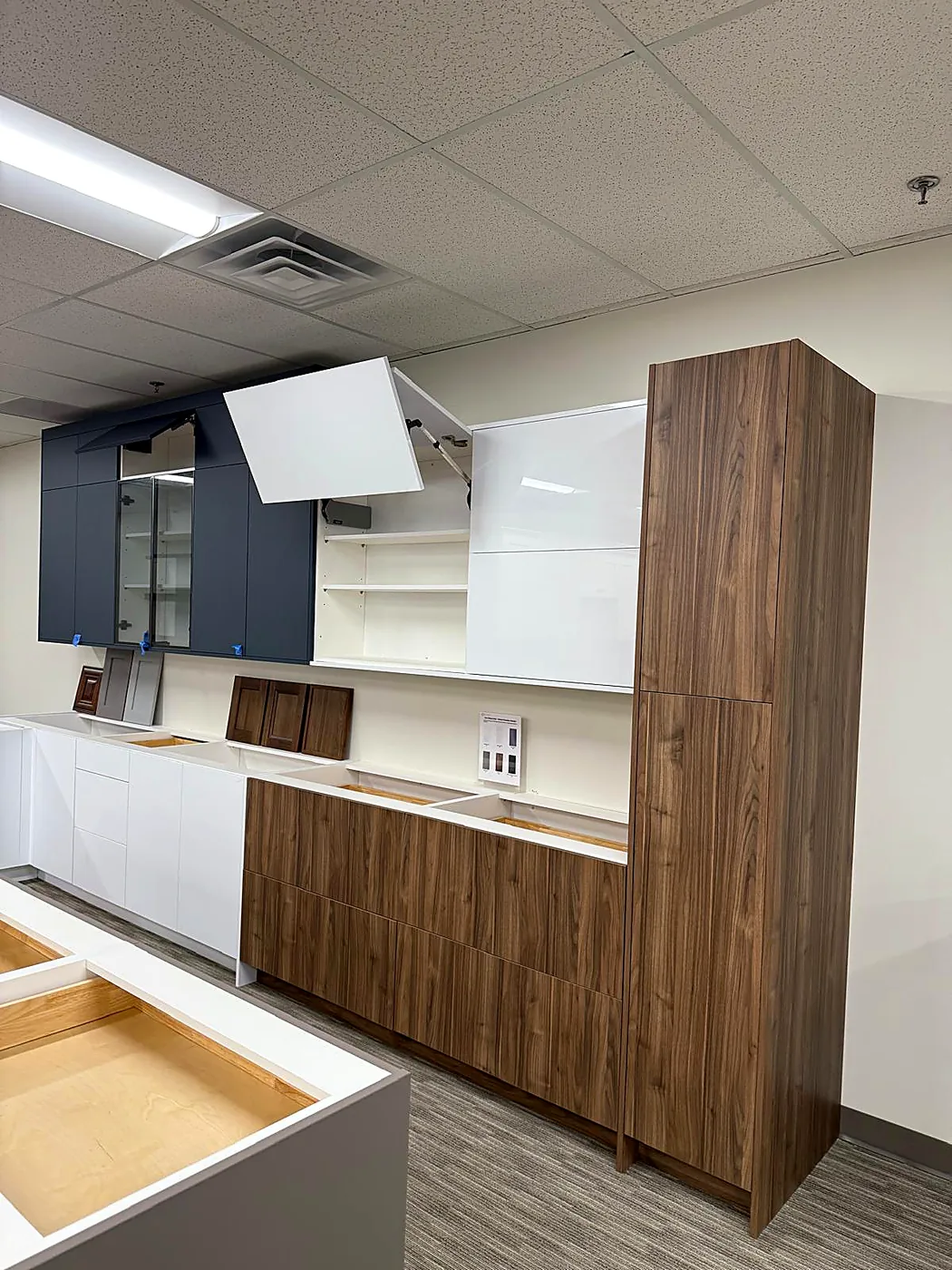
Door style alone doesn't require custom — our floor carries 36 styles across five collections: Shaker, Esca recessed panel, Raised Panel, Slim Shaker and Frameless European. Overlay is where the money separates.
Full overlay covers nearly the entire face frame, so the doors hide small variations. True inset sets the door flush inside the frame, putting every reveal on display. Inset costs more for unglamorous reasons: the frame must be heavier and dead square, doors need tighter machining, specialty hinges are involved, and hanging and adjusting each door takes far longer. Wood moves with humidity, so reveals get set with the season in mind. Numbers are in what inset cabinets cost in San Antonio.
Inside the box: drawer banks, roll-outs and dividers
The part you feel every day:
- Drawer banks instead of doors on base cabinets. Three deep drawers beat a door-and-shelf for pots — nothing hides at the back.
- Roll-out trays where you're keeping doors.
- Pull-outs: trash and recycling, sheet-pan and tray dividers, spice racks, blind-corner units.
- Drawer dividers, peg systems, and an outlet inside a drawer.
- Pantry shelf depth — 12" stays reachable, 16" hides cans behind cans.
Roll-outs and dividers can usually be retrofitted later. Turning a door base into a drawer bank cannot — that's a different cabinet.
Finish, including matching a color you already have
Custom finish means paint or stain to a specific color instead of a catalog swatch. It's most often used to solve a problem: matching a new island to existing cabinets, or adding a pantry to a kitchen finished years ago. Bring an actual door — a phone photo won't get you there.
Two cautions. New finish beside a ten-year-old finish reads slightly different because the old one has aged, especially where it's taken direct sun. And factory and shop finishes of the same color rarely match side by side — if a run must match, order it all the same way.
Specialty pieces that carry the design
Most of a kitchen's character comes from a handful of parts — these are the ones people actually go custom for:
- Hood surrounds — sized to a specific hood insert, which means you buy the hood first.
- Island end panels, decorative legs and corbels.
- Scribed panels cut to an uneven wall or an out-of-level floor.
- Full-height pantries built to your ceiling.
- Appliance panels for a panel-ready fridge or dishwasher, sized off the spec sheet.
- Light rail, riser molding and toe-kick drawers.
What can't be added later — and the hybrid most people choose
Locked at order time — changing them later means a new cabinet, not a modification: sizes and depths, overlay (especially inset), door style, finish color, drawer-bank vs door layout, hood surround and appliance panel dimensions, which ends are finished, and where the box is bored for a sink, cooktop or outlet. That's why appliances get chosen before the order — their spec sheets set the openings.
Which is why most customers don't order an all-custom kitchen. They take stock boxes for roughly 90% of the run and go custom on the three or four pieces doing the visual work — hood surround, island panels, full-height pantry, a scribed end. Most of the look, a fraction of the premium.
Browse the 36 stock styles to see which pieces you'd genuinely need built, then request a free quote with your appliance spec sheets — we'll price your layout all-custom and hybrid, so the premium is a number instead of a guess.
Free design + 3D rendering + in-home measurement on every project. Affirm financing available.
Get a Free Quote (726) 300-8438