Custom Cabinets in San Antonio: What They Cost and How to Choose a Shop
A local buyer’s guide — real price ranges, honest lead times, and how to vet a cabinet shop before you pay anything.
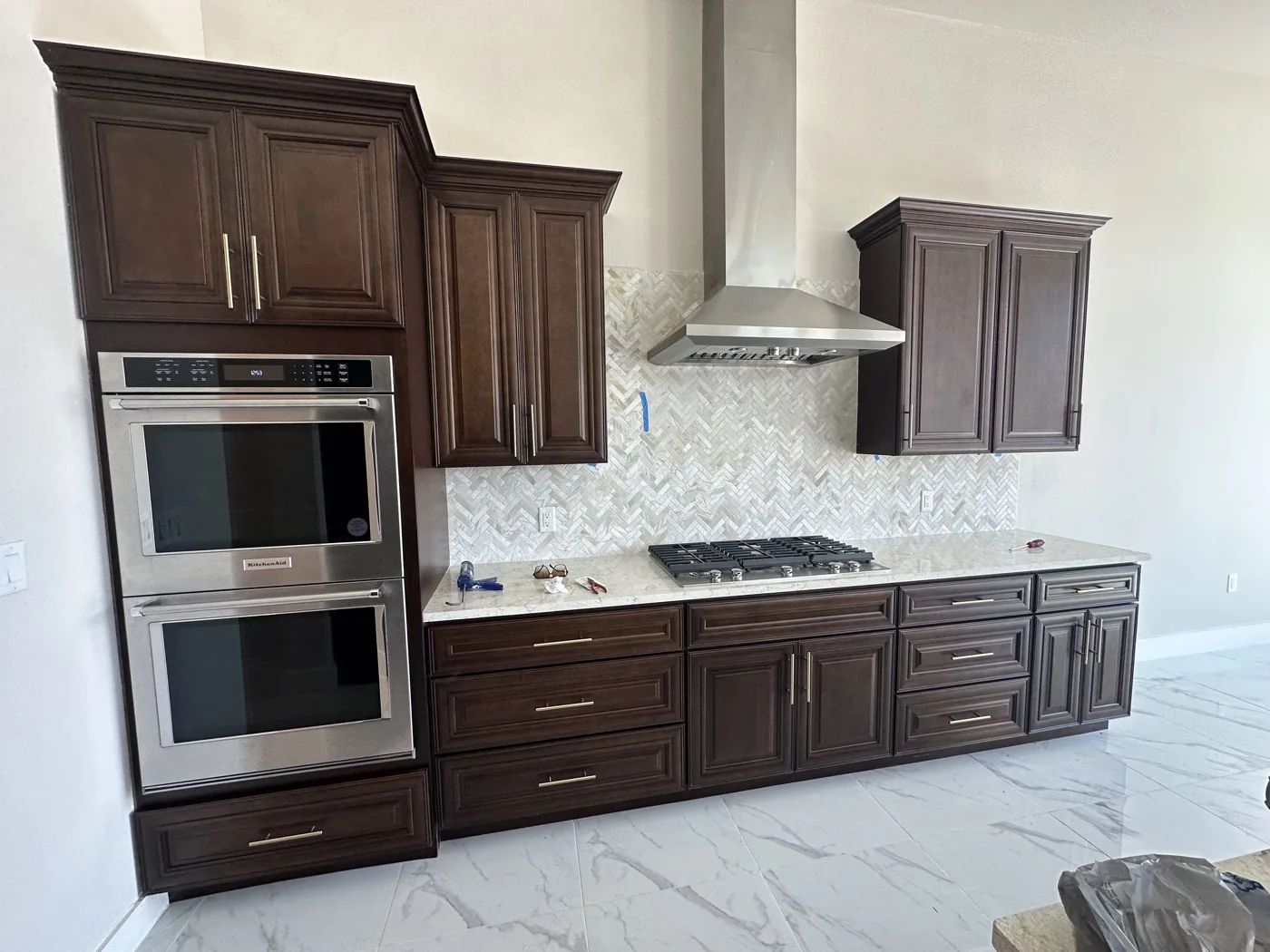
“Custom” is the least regulated word in this industry. It gets used for everything from a genuinely built-to-your-dimensions cabinet to a stock box with a nicer door. Here’s how to tell what you’re actually being quoted in San Antonio.
What "custom" means — and how the word gets stretched
Custom means the cabinet is built to dimensions you specify: width, height, depth, configuration. It doesn't exist until your order does. That's the whole definition, and it's the only one that changes what shows up on install day.
Three things commonly get sold as custom locally:
- A stock box with an upgraded door. The box is still a fixed size in 3" increments. A better door is a real upgrade — it just isn't custom, and it shouldn't carry a custom price.
- Semi-custom. A factory line with more door, finish and modification options. Genuinely more flexible than stock. Still a catalog.
- "Custom" that means the installer cuts fillers on site. That's ordinary carpentry, not custom cabinetry.
One question sorts it out: which cabinets in this quote are being built to my measurements, and which come in fixed sizes? How directly that gets answered tells you a lot about the shop.
What it actually costs in San Antonio
Priced on a 10×10 kitchen — roughly 20 linear feet, the benchmark nearly every shop here quotes against:
- $1,750–$3,000 — stock/budget shaker on plywood, fixed 3" increments, on the floor now.
- $3,000–$6,000 — premium and painted.
- $6,000–$12,000+ — custom including true inset, built to your dimensions.
Those are cabinet-only figures. Turn-key with counters and installation starts around $5,500, and most complete projects finish between $5,500 and $10,000. A quote called "custom" that lands well under that third band is something else.
Honest lead times
Custom typically runs 4–8 weeks in the shop, and install day isn't scheduled until the boxes are finished. In front of that sits design and approval — measuring, drawings, revisions, sign-off. Our free 3D design comes back in about 48 hours, but how long approval takes is on your calendar, not the shop's. In-stock cabinets skip the queue entirely: picked, delivered and installed in 1–2 days.
Be skeptical of anyone promising true custom far faster, and get the shop window in writing. Install week itself is covered in our installation timeline.
Seven questions to ask before you hand over a deposit
- Can I see the shop or showroom? Ask to stand in it and open drawers. A photo gallery and a phone number is not a shop.
- What is the box made of? You want ½" or ¾" plywood, not particleboard with a printed finish. See plywood vs MDF before you shop.
- Who installs — your crew or a subcontractor? Subs aren't automatically bad, but ask who you call when a door needs adjusting in month four. We install with our own in-house crew.
- What does the warranty cover, in writing, and who honors it? Ours is a 3-year workmanship warranty on our installation; product defects go through the manufacturer's warranty, which we file for you. Normal wear, water, moisture and heat damage and customer-supplied materials are excluded. Every warranty has exclusions — read them. Full terms on our warranty page.
- Will you itemize the quote? A line per cabinet with sizes, and counters, hardware and labor listed separately. A lump sum can quietly hide a tier swap.
- What are the deposit terms? How much, when the balance is due, and what is refundable once material has been cut.
- What happens if a measurement is wrong? Ask who pays to rebuild. It's why we do free in-home measurement ourselves rather than off a customer's sketch.
When custom is worth it here — and when it isn't
Stock cabinets come in 3" width increments, and odd walls get closed out with filler strips; one or two 3" fillers look completely normal. Custom earns its price where stock stops working:
- Ceilings above 9 feet, where you want cabinets running to the top instead of leaving a dust shelf.
- A settled, out-of-square wall (common in older ranches on expansive clay) that needs a scribed end panel rather than a filler.
- An odd depth: a 15"-deep upper over a desk or coffee station, or a shallow base beside a tight walkway.
- True inset doors, which need tolerances stock sizing doesn't hold.
- An existing finish you have to match rather than replace.
Here's the part fewer shops will say out loud. Skip custom when:
- Your kitchen is a squared-up 1990s-or-newer build with 8-ft ceilings and standard depths. Stock covers it, and a 3" filler disappears.
- You're selling or renting the house within a year.
- You need it finished inside eight weeks.
- Cabinets would consume the whole budget. Custom boxes under a bargain countertop is spending in the wrong order.
- You already like a door we stock. There are 36 styles across five collections; if one is right, custom buys you nothing.
What the custom premium actually buys
Exact sizing is most of it. Custom is quoted to the inch, so a 34½" opening gets a 34½" cabinet, and depth and height work the same way: a 15"-deep upper over a coffee station, or uppers that die into an 8-ft ceiling. Beyond sizing, custom construction genuinely adds:
- ¾" material throughout, including shelves, so long spans don't sag.
- Finished interiors and full-depth backs, visible through glass doors and on open ends.
- Integrated toe kicks and furniture bases instead of an applied kick.
- Nonstandard heights: a taller base under a raised counter, or an appliance garage.
Inset is where the money separates. Full overlay covers nearly the entire face frame, so the doors hide small variations. True inset sets the door flush inside the frame and puts every reveal on display, so the frame must be heavier and dead square, the doors need tighter machining and specialty hinges, and hanging and adjusting each door takes far longer.
Decide these before you order, because changing them later means a new cabinet, not a modification: sizes and depths, overlay, door style, finish color, drawer banks versus doors, hood-surround and appliance-panel dimensions, which ends are finished, and where the box is bored for a sink, cooktop or outlet. That is why appliances get chosen first: their spec sheets set the openings.
The hybrid most kitchens end up with. Few kitchens need to be all custom. The common move is stock boxes for about 90% of the run plus custom for the three or four pieces carrying the design: a hood surround, island end panels, a full-height pantry, a scribed end where the wall leans. That gets most of the look for a fraction of the premium. Judge any cabinet by the box, not by the tier name.
Where to start
Whatever shop you choose, get someone into your kitchen with a tape measure before signing anything. Sketch your layout in our free 3D designer, or request a free quote — we measure at no charge and send a design back in about 48 hours, priced in-stock and custom on the same layout. Showroom on Isom Rd, open seven days, bilingual team.
Free design + 3D rendering + in-home measurement on every project. Affirm financing available.
Get a Free Quote (210) 984-1615