Most cost guides lump the cabinets and the labor into one number. This one separates them — because when you're comparing quotes, installation labor is usually where the real differences hide.
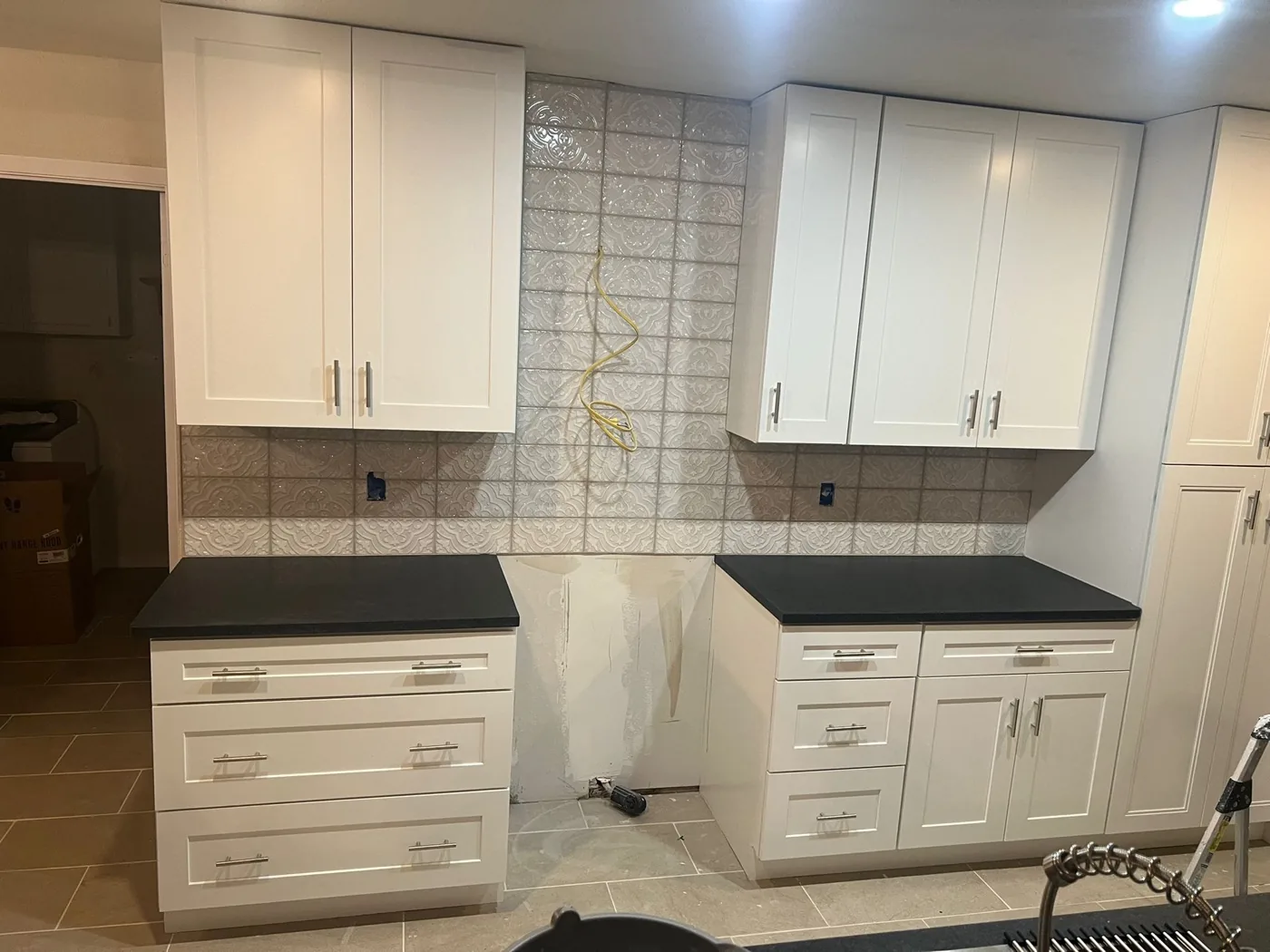
Cabinet price and installation labor are two different numbers
When a homeowner asks "how much does it cost to install kitchen cabinets," they usually mean one of two things: the whole project (cabinets plus labor), or the labor by itself. Both are fair questions, and mixing them up is the fastest way to misread a quote.
The cabinets themselves — boxes, doors, drawers, soft-close hardware — are the product cost. We cover that side in detail in our San Antonio kitchen cabinet cost guide (short version: in-stock cabinets for a standard 10×10 kitchen start at $1,750 at our showroom). This article is about the other half: what it costs to get those boxes assembled, leveled, anchored, and trimmed out in your actual kitchen.
Typical installation labor costs (honest industry ranges)
Installation labor is priced three common ways, and there's no single national standard — so treat published figures as ballparks, not promises. Across the industry, typical labor-only pricing for a standard install of stock or semi-custom cabinets tends to fall in these ranges:
- Per cabinet box: roughly $100–$300 per box for a straightforward install, with tall pantries, corner units, and glass-door uppers at the higher end.
- Per linear foot: roughly $50–$150 per linear foot for labor only. A 10×10 kitchen has about 20–25 linear feet of cabinetry, so labor-only bids often land somewhere between $1,500 and $3,500 nationally.
- Flat project bid: one number covering demo, assembly, installation, and trim. This is the easiest to compare — as long as you confirm what's inside it.
Those ranges assume the cabinets show up correct and the walls cooperate. Custom cabinetry, layout changes, or a house that's settled unevenly can push labor well above them — which brings us to the real question.
What actually drives cabinet installation labor cost
Two kitchens with the exact same cabinets can have very different labor bills. Here's what moves the number.
Demolition and tear-out
Removing old cabinets, disposing of them, and prepping the walls is real work — usually several hours to a full day. Some installers include it; many quote it separately. Always ask, because "install" without demo can hide a surprise line item.
Layout changes
Keeping your existing footprint is the single biggest saver. The moment cabinets move to a new wall, you're coordinating plumbing, gas, and electrical work on top of carpentry — and the labor bill grows with every trade involved.
Wall condition in older San Antonio homes
Plenty of homes inside Loop 410 have decades of settling behind them. Out-of-plumb walls, wavy plaster, and floors that slope a half inch across the room don't stop an install, but they add shimming and scribing time. A good installer levels the cabinets to true, not to the wall — that's the difference between doors that line up for years and doors that sag in months.
Soffits, crown molding, and trim
Removing an old soffit to run cabinets to the ceiling adds drywall work. Crown molding, light rail, matching end panels, and filler strips all add cut-and-fit time — they're also what makes a kitchen look finished, so they're usually worth budgeting for.
Islands and anchoring
An island isn't just more boxes. It has to be anchored to the floor dead level and square, because a stone countertop is going on top of it and stone doesn't flex. Waterfall edges and seating overhangs raise the precision bar further.
Who installs your cabinets matters as much as the price
In San Antonio you'll generally be choosing between three kinds of installer, and the differences show up after something goes wrong, not before.
| Factor | Big-box store (subcontracted) | Independent handyman | Local shop with in-house crew |
|---|---|---|---|
| Who measures | A third-party measuring service, often for a fee | You, or the handyman informally | The shop's own team, typically free |
| Accountability | Split between store, brand, and subcontractor — issues can bounce between them | One person; depends entirely on the individual | One company owns the cabinets and the install |
| Timeline | Scheduled around the subcontractor's queue | Flexible but variable | Scheduled directly with the crew |
| Workmanship warranty | Varies by program and installer | Rarely written down | Written warranty from the shop |
| If cabinets arrive damaged | Reorder through the store, wait for the next window | Your problem to resolve with the seller | The shop replaces from its own stock |
None of these options is automatically wrong — plenty of independent installers do excellent work. The pattern to notice is accountability: when the company that sold the cabinets also measures the kitchen and employs the installers, there's nobody to point fingers at. A measurement error, a damaged box, a door that won't align — it's all the same phone number.
What installation looks like at WoodArt
We're a family-owned showroom on Isom Rd, and we keep the whole chain in-house. Here's what that means in practice, using our real published numbers:
- Free in-home measurement. Our team measures your kitchen before anything is ordered — see our free in-home measurement service, or start with the DIY measuring guide for a rough count.
- Free 3D design in about 48 hours, so you approve the exact layout before committing.
- Turn-key full kitchen install from $5,500 for a standard 10×10 — cabinets, counters, hardware, and installation in one package, so you're not assembling separate labor bids.
- In-house bilingual install crew. The people in your kitchen work for us, not a subcontractor network. Details on our installation page.
- Typical cabinet install: 1–2 days. Full remodels with countertops and more run about 5–10 days — the full schedule is in our installation timeline guide.
- 3-year workmanship warranty on the install, in writing — see the warranty page.
- Monthly payments through Affirm with instant pre-qualification and no impact to your credit score — details on our financing page.
Frequently asked questions
How much does labor-only cabinet installation cost?
Industry-typical labor-only pricing runs roughly $100–$300 per cabinet box or $50–$150 per linear foot for a standard install, so a 10×10 kitchen often lands between $1,500 and $3,500 in labor nationally. Demo, layout changes, and trim work push it higher. If you're buying cabinets and install together, compare the total package price instead — that's the number that actually hits your budget.
What does cabinet installation cost per linear foot?
Labor-only, a typical industry range is about $50–$150 per linear foot for stock or semi-custom cabinets in an existing layout. Quotes that sound dramatically cheaper often exclude demolition, assembly, or trim — read the line items before comparing.
Can countertops be installed at the same time as cabinets?
Not on the same day — countertops are templated after the cabinets are set, because stone is cut to the installed cabinets, not to the drawings. They're part of the same project, though: our turn-key package covers cabinets and counters under one schedule, with the cabinet install itself typically taking 1–2 days.
Is DIY cabinet installation worth it?
If you're handy, patient, and your walls are reasonably straight, a small kitchen is a realistic weekend-plus project. The risks are leveling errors (every countertop problem starts with unlevel cabinets), wall-anchoring mistakes on heavy uppers, and voided countertop warranties if the fabricator won't template over a DIY base. If a stone countertop is going on top, professional installation is cheap insurance.
Get a real number for your kitchen
Visit our showroom at 431 Isom Rd or book a free in-home measurement — we'll quote your exact kitchen, cabinets and installation together, with no obligation.